Advertising Budget and Break-Even Calculator
Work backwards from real profit margin to find a defensible test budget and bid ceiling.
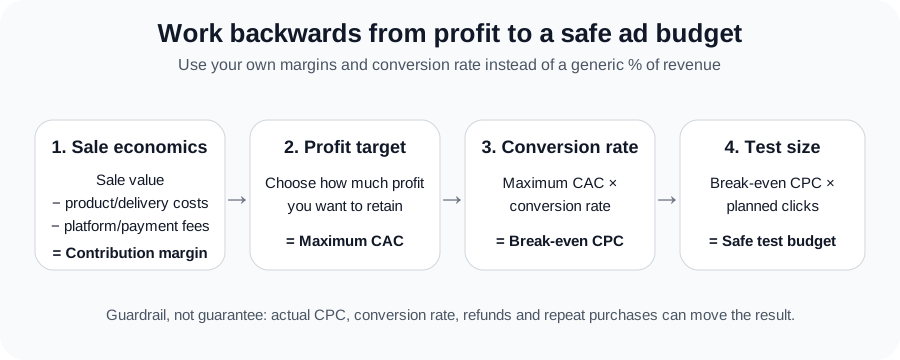
What this calculator shows
It subtracts direct product costs and percentage fees from each sale to find contribution margin. Your retained-profit target sets the maximum customer-acquisition cost. Conversion rate then translates that ceiling into a maximum average cost per click and campaign test budget.
How to use it
Use average order value rather than the highest product price. Include production, fulfilment, marketplace and payment costs directly tied to a sale. Use a measured conversion rate from similar traffic when available; otherwise test several cautious rates because this input has the largest effect.
Useful examples
- Finding a maximum CPC before launching a Google or social campaign.
- Checking whether a low-priced digital product can afford paid acquisition.
- Comparing the value of improving conversion rate with raising the advertising budget.
- Setting a controlled learning budget for a new offer with limited data.
Important limits
Real performance varies by audience, creative, attribution window, refunds, repeat purchases and tax. A small test can be statistically noisy. Never spend money needed for essential bills, and set platform account limits independently.
How much should an advertising test spend?
The budget needs enough clicks to provide useful evidence but must remain within an affordable loss limit. Start with the economics of one sale. Contribution margin is the sale amount remaining after the costs that happen because the sale occurred. The campaign cannot sustainably pay more than that amount to acquire a customer unless repeat purchase value is reliable and measured.
Conversion rate connects clicks with sales. At a 2% conversion rate, roughly two sales are expected per 100 clicks over a sufficiently large sample. If the maximum affordable acquisition cost is $27, the equivalent CPC ceiling is about $0.54. Paying above that level would miss the chosen profit target unless another part of the funnel improves.
Worked example
A $49 product with $8 direct cost and 10% fees leaves $36.10 contribution per sale. Retaining 25% of that contribution permits a maximum acquisition cost of $27.08. At a 2% conversion rate, the maximum CPC is about $0.54, so a 500-click test budget is about $270.75. Ten expected sales would leave about $90.25 campaign profit before fixed overhead and tax.
Use the result as a guardrail
Track actual CPC, conversion rate, acquisition cost and refund-adjusted contribution. Pause or revise the campaign when evidence shows the economics are outside the guardrail. If conversions are too few to judge, improve the landing page, offer or tracking before assuming that a larger budget will solve the problem.